Monday, November 30, 2009

A Deserted Campus and Washington Rock Star

The hall was eerily quiet for about three days, and a total of about 5 people remained on the floor. I had mixed feelings.

But, I am glad for not having gone home for Thanksgiving, as with all the turbulence currently at home, I would get absolutely no work done over the weekend and have a royally painful time adjusting to the old rhythm (plus, I would've wasted 1 whole day on transportation alone).

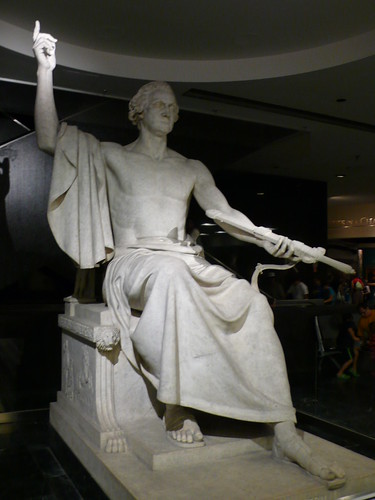
Anyhoo, we had a good break. Getting more acquainted with DC is a pleasure, and Aline and I performed some community and identity analysis ourselves at the National Museum of American History. I was particularly intrigued and amused by this Washington statue, a bold and audacious statement, basically presenting the father of USA as an almighty greek deity. So much for analyzing Stuart's National Portrait Gallery painting and searching for symbols of royalty, when Greenough's statue emanates god-likeness.

This is curious as well, because the painting was created in Washington's lifetime, still (painted in 1796, he died in 1799), while the statue was erected in 1841. Thus such was the artist's perception of Washington in that day. Here's some facts:

Greenough’s sculpture is enriched with symbols: Washington’s figure is modeled on the classic statuary of ancient Greece, seat of the world’s first democracy. Carvings on the sides depict the Greek god Apollo and an infant Hercules. Small flanking figures of an American Indian and Christopher Columbus represent the New and Old Worlds. The most important symbol, however, is the sword in Washington’s outstretched hand: this celebrates the fact that after he led the country to victory in the American Revolution, he selflessly relinquished his power to the people.

Symbolism, symbolism. Aline thought it was way too rash and obvious, I thought it rather silly and for the founder to be an almost toga'd rock star (Yeah, liberty, but also - 'Are you ready to rock?!'). Huh. Wonder what Washington himself would make of it?


Note
"Landmark Object: George Washington Statue, 1841." NMAH. Smithsonian National Museum of American History. 29 Nov. 2009
. <http://americanhistory.si.edu/news/factsheet.cfm?key=30&newskey=779>.

Saturday, November 28, 2009

I Just Got Lost & Some Quality Time With Dan Brown

This Thanksgiving break was such a great one!! After hectic months of going to class, work, or volunteering at the Newseum, it was nice to slow my pace down and just enjoy the city. Yes, I didn't go home for the break, and now I learned that trying to buy airplane tickets at the last minute is not a great or cheap idea. However, it's not like DC is a boring city. So between going to the Smithsonians, getting lost trying to find another museum, getting lost trying to find the German embassy (except that this time with Gunperi), having dinner in Georgetown, and spending Thanksgiving with Anna's wonderful family; I must say that this break was a very good one.

One thing I learned about myself during this break is how much I don't freak out anymore. For example, when Alex and I were looking for the old postal office that's near the Washington Monument, we got lost. Yes, believe it or not, Alex and I could not find a giant building that has a giant tower, with a giant clock on it. Even though we asked a security guard for directions, and even though we were carrying a map, we still could not find that building. When we finally found it, it was only to be told that it was closed. It was at that moment that I realized two things. One, I seriously need to improve my map reading skills. Two, I don't panic as much as I used to. If a year ago I would've gotten lost the way Alex and I did, I would've worried and panicked at the idea of being lost in a city I wasn't accustomed to. Nevertheless, that's not the situation anymore. In fact, I enjoyed getting lost, I saw new parts of the city that I did not know were there. Did you know that there's a Barnes & Noble on I believe it was 10th street? Or was it 11th? I don't remember but it's somewhere around there. Anyway, I think that I've become a bit more spontaneous and unplanned, which to tie it back to class, I guess I have been absorbing the advice that has been given to us by guest speakers. The advice that we shouldn't plan or organize our life so much, just let life take its own course. Yes, maybe we'll get lost but there's always the chance that you'll end up liking it.

Just to add a quick note, I would like to thank Anna W., Alex, and Gunperi for making this Thanksgiving break an enjoyable one. Also, my friend Adam for lending me his book "The Lost Symbol" by Dan Brown. Yes the writing sucks, but the story is great!! Especially because it's set in DC. I've actually found that some of the areas described here I've visited which only adds to the excitement. I really recommend it. So, to sum it all up, great break, good times, and now it's hard work until finals are over.

Thursday, November 26, 2009

Reflecting on Thanksgiving Day: I feel too grown up

This reflection is early but I did not want to wait until tomorrow or this weekend to post it because tomorrow I must awake at 4 am for work at 5am-- oh the joys of working in retail. And the rest of the weekend will fly by and then I will be back at AU on Sunday. Though, I can honestly say that I do not want to leave, and I have only been here one day. Maybe it is because of the fact that I haven't seen these people-- family, friends, and co- workers-- in so long, but it also reminds me of how easy life was and having the comforts of home all the time. But it is true that absence makes the heart grow fonder because it just makes me appreciate it all so much more. Thank goodness I will be able to come back in two more weeks. I will admit that 1st semester went by fast, but I expected that at the same time. There is always so much to do and I found myself having to plan everyday just so that I would not forget anything.

Today I found myself comparing this Thanksgiving to last year's, and geez so many things were different. First of all less relatives came and my boyfriend came instead. Also, just being back at home last night was weird. The first difference I noticed was that the ceiling in my house is so much lower than that of the dorms! So everything kind of felt smaller, though my room at home is definitely bringer than our dorm room. Speaking of my room, my mom cleaned it so it looks totally different! It needed a face lift though.

Anyways, I do not think that I am appropriately reflecting in this post so I will proceed to do more of that now. I think that the reason that history is so important, and that when Ambassador Quainton came to talk to us and he relayed that he studied history in grad and undergrad, because it is the most important way in which we feel as though we can predict the future. For instance, I loved this quote on Allie Cat's blog post: "It is interesting to note that many of the famous revolutions of history involve a dissolution and later reorganization of their country's military, including the French and Russian. Military and society are tied together- if one falls, so will the other." I think that she is correct in her comment, and it is true that future will contain repeats of the past. The way in which we move forward, like by dissolving the country's military, is by taking notes on what others in the past did. I love drawing parallels in my posts about my real life and the theoretical ideas which we talk about, and I am going to attempt to do so in this post as well.

Basically, being back at home flooded me with memories of the past. It was crazy how everything I did reminded me of the last time I was there, and at its core, I think that the reason for traditions and maintaining holidays is to remember the past and not forget what has happened. Holidays serve to remind us of our personal histories that make up our life, and act as a day of reflection in themselves-- an imaginary pause button. And as from learning from the past, we attempt to learn, though sometimes it is unsuccessful, from our past mistakes and what went wrong from holidays so that the bad traditions to not live on and the good ones sustain themselves. Just as disgruntled citizens desire to recreate their countries military to obtain power, so do we, ordinary citizens, attempt to learn from past mistakes and hold on to the good memories so that we can continue to reinvent and recreate our holidays and other silly/ sentimental traditions. Hope that makes sense and it is not too much of a stretch.

PS: HAPPY THANKSGIVING. This is one of my favorite traditions for today.

Monday, November 23, 2009

My nose and furry mukluks

What a stunning museum! I missed the Wednesday lab but was just as thrilled to explore the National Museum of the American Indian by myself. I am finding anthropology to be one of those exhilarating academic fields that sends chills down my spine... plus they had an exhibit on the Quechua tribe, with llama-skin sandals, flutes, and all. Splendid!

Bonus Q:
Whose values are expressed in the National Museum of the American Indian? How are remembrance and othering manifest in the museum's layout and presentation of artifacts?
Whose values? To me it appeared the values expressed were those of the "Community Curators" posted before every tribal entrance on the 4th floor. These people seemed to be ones who had helped in the consolidation of the their tribe's rituals and traditions, ones who most probably helped outline the most important aspects of their past and current culture.

Or was it the values foreign anthropologists deemed exemplary? What were those "Community Curators" doing up there?

As goes for the manifestation of remembrance, there was a plethora of examples. The display of the Denver March Powwow memorabilia was an easy representation of how the folk dances and songs of the American Indians are preserved to this day at annual contests and celebrations. The usage of natural, earthy colors in the design (yellows, reds, browns), smooth, curvy architecture, rock-like flooring, flowing staircases, and dusky, dimmed lighting all established an almost mystical ambiance with intention to preserve aspects of the physical world of the American Indians. This mystique generates awe, respect, and yes, reignites a remembrance of the Indian ways.

(Although, back to terms of values, I feel the layout and majority of the museum’s presentation focus specifically on the physical realities of Northern American Indians [the term 'American Indians' encompasses Central and South American Indians, too. In fact, people in Central and South America tend to call themselves Americans as much as we do. Side note – US Americans are called gringos or estadounidenses.])

Wow... there was one especially dramatic and impressive display, the "We are the Evidence" wall, which lit up the names of many (not all) of the tribes that had been decimated after "Contact" (with the Europeans), in a sweeping eye-of-the-storm form. The Quechuas, Lakotas, Huapas, Mapuches… and Andean Quichas, Quechas, Aymaras, Callhuayas.

The manifestations of othering within the layout and artifacts included hung tribal flags in the middle of the first floor, specifically delineating boundaries of tribes within and visitors outside; yet, for the most part, I found the manifestations of “othering” welcoming. Visitors are not solitary and excluded in their perusal of the museum, the learning is not a “cold” examination, one does not apperceive a feel of great distance between the self and the Indian peoples of the past and present. Instead, one is accompanied by narrated cartoon stories and welcoming interactive modules that open the outsider boundary. But, the most spell-bounding aspect of the presentation, again, the mystique, for me… was the glass.
I, as incoming visitor, peeked in to view the artifacts through the glass, but my eyes perceived not only the given costume I was attempting to examine, but also, a spooky, phantasmal, reflection of myself. As I moved, the reflection flowed and distorted my figure, softly warping my shape and face and granting me the opportunity to view myself as I viewed the American Indians. This happened on all the artifacts, electronic displays… I have reasons to believe that reflective glass is there for a purpose. That reflective glass opens community boundaries and yes, invites the visitors to generate their own comparisons to the tribespeople.

As I peered at both my reflected nose and a mannequin dressed in parka and fur mukluks, I certainly did, side-by-side, muse on my relation to the universe of the American Indians.

Reflection

I was extremely pleased to see that the museum of the american indian was done in an informative, respectful, and mindful manner. I say this because it's easy to devote a museum solely to the "interesting" parts of a culture, and I was glad to see that the museum was quite thorough in the way that the information was presented. For example, there was only a small exhibit on General Custer's defeat at Little Big Horn, an example of the traditionally "exciting" aspects of Native American culture, and there was much more on the day to day life of the modern Native American. I was happy to see the stereotypical "Indian" very much downplayed, and I was also happy to learn things I had never known, like the living conditions on reservations and the struggles of some of the modern Native Americans to stay close to their roots.
I was very taken aback by the architecture of the museum, to me, it was the best part. Everything seemed to flow and curve, it seemed the embodiment of the natural flow of life that the Native Americans believe in so firmly. just standing in the middle of the big circle on the ground floor and looking up, I couldn't see a single sharp angle or corner. It was very impressive. I really enjoy going to museums where the architecture matches the content; it enhances the experience greatly. In short, I thought that the Museum of the American Indian was a fitting tribute to our land's earliest occupants.

Army Attitudes

Thinking in retrospect to Ana's comments in class about illegal aliens and military duty, I at last had remembered my friend Christina, whose Guatemalan mother, after fleeing from the Guatemalan Civil War in the 1980s, had enlisted in the US army. She received a college education as result, and thus moved her family up from severe poverty to the middle class Christina is at today. (Reading Annie's blog post and personal story triggered this memory, as well).

So... is the military a social-mobility solution for immigrants, as well? (See Annie's post).

I was an upper-class mentor for freshman students in my high school back home. Around 50% of the kids were Hispanic, most first-generation immigrants from Mexico. I did my best to advertise college and the rewards of diligently doing their homework every day. Yet, instead of enthusiasm for further schooling, once taking each student on a one-on-one conference, all I heard is "I'll just join the army."

Not only was I awestruck, I was angered, exasperated. Why weren't these kids listening? What was so attractive about the army? Had this been promoted within their families? Within their communities?

In all, was this one of the three: (1) an easy way out and good excuse for not performing well (for reasons of sheer laziness) in school, (2) a bamboozlement of the kids, who had been so impressed by the "Army of One/Army Strong" commercials (and service men at the cafeteria table), or, (3) a feasible solution (discussed with family, cogitated upon) to rise from their current social status?

Quite honestly, these terms of thinking I have elaborated only now. Previously my logic must have been much simpler. But now, as I connect the dots, I notice the certain immigrant allurement with military service might just have something to it.

Sunday, November 22, 2009

Bonus Blog Question

Though the museum was very open in space, the exhibitions themselves felt crowded. Artifacts placed in the upper levels were positioned in ways in which the visitor had to go through a pathway in order to observe them. It almost felt as if I were in a maze. Though at first I did not understand this order of placement, I now realize that the visitor could become even more engaged in the museum if he or she were to choose to dive into the exhibitions in order to look at the artifacts. As a visitor, I was engaged. Having to go and actually seek for artifacts captured my attention more than if the artifacts were just placed in wide, open, and visible areas. Due to the lack of space in the exhibition, I submerged myself in a history that I must admit, I am a bit ignorant of. I became surrounded by history and was therefore more receptive of the portrayed cultures.

Lighting was also an interesting factor of the museum. In the fourth floor, the lighting of the exhibitions was dimmed and focused solely on the artifacts. Due to the lack of light, I began to feel as if I were in a mystical place. I kind of don't really know how to describe this mood with another word besides "mystical." It's just that something felt kind of mysterious about the whole atmosphere. Maybe it was to reflect how Native Americans were not really rooted to solid ideas but rather to abstract forms of thinking. What I mean, is that many of their beliefs seemed to be centered on things such as folklore or finding symbols in objects rather than focusing on actual scientific fact. Maybe this was the whole reason behind the layout, to reinforce the idea that this culture was an abstract one.