Showing posts with label Alex. Show all posts

Sunday, December 6, 2009

Plusssz, not Alka-Seltzer, and Lots of... Fizzing

Final reflection. And what of this finale? From Goffman to Augustine to Bellah to Sophocles to Heinlein, what have I learned?

I am somewhat intimidated by the feat of encapsulating my entire Explorations experience and wisdom into one easy-to-swallow pill. As far as medicine goes, this course material is more like Alka-Seltzer. The tablet slowly fizzes in, and you have to swallow it with a few gulps of diluting water. Or, sometimes you swallow the tablet before it has done its fizzing, and you're left to churn out the medicine on the inside.

More liquid than solid. Yeah?

I guess what I am saying is that, although the Explorations content was perchance difficult to grasp, to beat into form, the topics, like liquid medicine, are still essential. And yes, it might take longer than usual to swallow (the waiting, the fizzing, the gulping), and even for the medicine to take effect (maybe it's still fizzing for some... or got swallowed in the fizzing process) no doubt it will kick in. Community matters and analysis are too pertinent for us, as members of the human race, to be ignored. We are not independent beings, and every day you and I are shaped by the places and groups we find ourselves in.

And the fun part is, upon educating ourselves on the topic, we, in a way, become masters of it. We are enabled to make more deliberate decisions. We enrich our waking experience with another dimension. We turn more conscious and aware as living, alive human beings... and that's a beautiful thing.

Have a phenomenal, ecstatic, out-of-this-world, super-cosmically-fantastic break, everyone! May your Holidays be full of love, joy, and cake. All sorts of cake. And splendid food and Home Alone reruns. And not too much snow and frost. (:

Note: I inserted the "Plusssz" picture, as actually, that's what I thought of all along in my metaphor - not Alka-Seltzer, but fizzing, fruity, Polish vitamins. Much tastier.

Thursday, December 3, 2009

Joining communities

There are a multitude of communities I aspire to join. Based on my dreams and goals, I aspire to become millionaire and join a community of philanthropists, I aspire to become an academic and join a community of researchers, I aspire to write books and join a community of authors that stimulate people's imaginations and perceptions of the universe, a community of travelers and travel-writers, and further explore the world in its magnificence, a community of dance performers, of musicians, artists, and, most physically, a friendly Spanish barrio community in Madrid or Barcelona where I will own a cozy, beautiful home next to the best bakery in town (I love waking up to the smell of baked bread).

Actually, I suspect I plan on moving back to Europe because I am drawn to the small community-bonded way of life that I remember from my childhood.

I aspire to join all these communities because they involve things which greatly interest me and that I love and enjoy. I am glad the question "How do you aspire to join it?" was not asked - that's a matter much too complex, and all I could say is that I am joining them by focusing on the end result.

Monday, November 30, 2009

A Deserted Campus and Washington Rock Star

The hall was eerily quiet for about three days, and a total of about 5 people remained on the floor. I had mixed feelings.

But, I am glad for not having gone home for Thanksgiving, as with all the turbulence currently at home, I would get absolutely no work done over the weekend and have a royally painful time adjusting to the old rhythm (plus, I would've wasted 1 whole day on transportation alone).

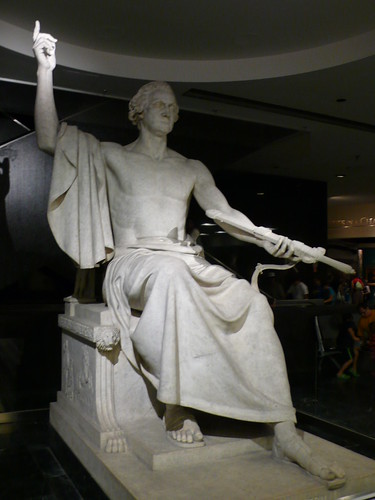
Anyhoo, we had a good break. Getting more acquainted with DC is a pleasure, and Aline and I performed some community and identity analysis ourselves at the National Museum of American History. I was particularly intrigued and amused by this Washington statue, a bold and audacious statement, basically presenting the father of USA as an almighty greek deity. So much for analyzing Stuart's National Portrait Gallery painting and searching for symbols of royalty, when Greenough's statue emanates god-likeness.

This is curious as well, because the painting was created in Washington's lifetime, still (painted in 1796, he died in 1799), while the statue was erected in 1841. Thus such was the artist's perception of Washington in that day. Here's some facts:

Greenough’s sculpture is enriched with symbols: Washington’s figure is modeled on the classic statuary of ancient Greece, seat of the world’s first democracy. Carvings on the sides depict the Greek god Apollo and an infant Hercules. Small flanking figures of an American Indian and Christopher Columbus represent the New and Old Worlds. The most important symbol, however, is the sword in Washington’s outstretched hand: this celebrates the fact that after he led the country to victory in the American Revolution, he selflessly relinquished his power to the people.

Symbolism, symbolism. Aline thought it was way too rash and obvious, I thought it rather silly and for the founder to be an almost toga'd rock star (Yeah, liberty, but also - 'Are you ready to rock?!'). Huh. Wonder what Washington himself would make of it?


Note
"Landmark Object: George Washington Statue, 1841." NMAH. Smithsonian National Museum of American History. 29 Nov. 2009
. <http://americanhistory.si.edu/news/factsheet.cfm?key=30&newskey=779>.

Monday, November 23, 2009

My nose and furry mukluks

What a stunning museum! I missed the Wednesday lab but was just as thrilled to explore the National Museum of the American Indian by myself. I am finding anthropology to be one of those exhilarating academic fields that sends chills down my spine... plus they had an exhibit on the Quechua tribe, with llama-skin sandals, flutes, and all. Splendid!

Bonus Q:
Whose values are expressed in the National Museum of the American Indian? How are remembrance and othering manifest in the museum's layout and presentation of artifacts?
Whose values? To me it appeared the values expressed were those of the "Community Curators" posted before every tribal entrance on the 4th floor. These people seemed to be ones who had helped in the consolidation of the their tribe's rituals and traditions, ones who most probably helped outline the most important aspects of their past and current culture.

Or was it the values foreign anthropologists deemed exemplary? What were those "Community Curators" doing up there?

As goes for the manifestation of remembrance, there was a plethora of examples. The display of the Denver March Powwow memorabilia was an easy representation of how the folk dances and songs of the American Indians are preserved to this day at annual contests and celebrations. The usage of natural, earthy colors in the design (yellows, reds, browns), smooth, curvy architecture, rock-like flooring, flowing staircases, and dusky, dimmed lighting all established an almost mystical ambiance with intention to preserve aspects of the physical world of the American Indians. This mystique generates awe, respect, and yes, reignites a remembrance of the Indian ways.

(Although, back to terms of values, I feel the layout and majority of the museum’s presentation focus specifically on the physical realities of Northern American Indians [the term 'American Indians' encompasses Central and South American Indians, too. In fact, people in Central and South America tend to call themselves Americans as much as we do. Side note – US Americans are called gringos or estadounidenses.])

Wow... there was one especially dramatic and impressive display, the "We are the Evidence" wall, which lit up the names of many (not all) of the tribes that had been decimated after "Contact" (with the Europeans), in a sweeping eye-of-the-storm form. The Quechuas, Lakotas, Huapas, Mapuches… and Andean Quichas, Quechas, Aymaras, Callhuayas.

The manifestations of othering within the layout and artifacts included hung tribal flags in the middle of the first floor, specifically delineating boundaries of tribes within and visitors outside; yet, for the most part, I found the manifestations of “othering” welcoming. Visitors are not solitary and excluded in their perusal of the museum, the learning is not a “cold” examination, one does not apperceive a feel of great distance between the self and the Indian peoples of the past and present. Instead, one is accompanied by narrated cartoon stories and welcoming interactive modules that open the outsider boundary. But, the most spell-bounding aspect of the presentation, again, the mystique, for me… was the glass.
I, as incoming visitor, peeked in to view the artifacts through the glass, but my eyes perceived not only the given costume I was attempting to examine, but also, a spooky, phantasmal, reflection of myself. As I moved, the reflection flowed and distorted my figure, softly warping my shape and face and granting me the opportunity to view myself as I viewed the American Indians. This happened on all the artifacts, electronic displays… I have reasons to believe that reflective glass is there for a purpose. That reflective glass opens community boundaries and yes, invites the visitors to generate their own comparisons to the tribespeople.

As I peered at both my reflected nose and a mannequin dressed in parka and fur mukluks, I certainly did, side-by-side, muse on my relation to the universe of the American Indians.

Army Attitudes

Thinking in retrospect to Ana's comments in class about illegal aliens and military duty, I at last had remembered my friend Christina, whose Guatemalan mother, after fleeing from the Guatemalan Civil War in the 1980s, had enlisted in the US army. She received a college education as result, and thus moved her family up from severe poverty to the middle class Christina is at today. (Reading Annie's blog post and personal story triggered this memory, as well).

So... is the military a social-mobility solution for immigrants, as well? (See Annie's post).

I was an upper-class mentor for freshman students in my high school back home. Around 50% of the kids were Hispanic, most first-generation immigrants from Mexico. I did my best to advertise college and the rewards of diligently doing their homework every day. Yet, instead of enthusiasm for further schooling, once taking each student on a one-on-one conference, all I heard is "I'll just join the army."

Not only was I awestruck, I was angered, exasperated. Why weren't these kids listening? What was so attractive about the army? Had this been promoted within their families? Within their communities?

In all, was this one of the three: (1) an easy way out and good excuse for not performing well (for reasons of sheer laziness) in school, (2) a bamboozlement of the kids, who had been so impressed by the "Army of One/Army Strong" commercials (and service men at the cafeteria table), or, (3) a feasible solution (discussed with family, cogitated upon) to rise from their current social status?

Quite honestly, these terms of thinking I have elaborated only now. Previously my logic must have been much simpler. But now, as I connect the dots, I notice the certain immigrant allurement with military service might just have something to it.

Thursday, November 19, 2009

I might fail to reject, but nevertheless...


"Violence, naked force, has settled more issues in history than has any other factor, and the contrary opinion is wishful thinking at its worst. Breed that forget this basic truth have always paid for it with their lives and freedoms." -- Starship Troopers, p. 27.

Justin (1) tried to list "nonviolent heroes," but concluded his list wasn't anywhere near exhaustive. Belle (2) posted that:

You can spend hours and hours trying to convince someone to do something verbally, but at any point they can change their mind and back out. When violence is involved, it usually only takes a few seconds to get a person to do what you want them to.

And Ariel (3) stated:

I don't know when or why, but sometime in my 18 years, I realized that humans are not a inherently nice race. Granted, there are individuals who are good and make huge contributions to society, but when it comes to International relations and cooperation on a systemic level, I lean towards a realist perspective.

Evidently, the majority of us are pessimistic. And I can understand how refreshing US History's Trail of Tears and the effects of violence on Native Americans can impact a perspective.

To counter some made claims - (1) - not being familiar with more nonviolent heroes is a matter of knowing our world history. Please see this slideshow, and additionally consider Otpor (see image), the Serbian Youth Movement that stirred up
the whole nation and overthrew the corrupt and tyrannical, President Slobodan Milošević in 2000.

(2) - As goes for convincing, I believe the best way to influence someone's actions is to think of the matter in terms of their point of view, and clearly present to them their interests and potential benefits. Could Indian removal and the Trail of Tears have been solved differently by Jackson? Maybe this is silly, but with the right incentives, could a compromise be reached between the moving settlers and the Native Americans?

I believe violence is the "human," natural, impulsive, instinctual thing to do - but that does not mean it is right, or actually, most effective. There is truth to the statement that violence has settled issues, that wars have granted freedoms. (This is kind of like null hypothesis in Stats... I fail to reject, but that does not mean I accept.) Frankly, I do not think I am doomed to pay for my optimistic thinking with my rights and freedoms.

Also, from what is seen to me in daily life, at the least, is that ones who restrain that instinct to infuriate and use bodily force achieve more of their aims. Really, to think about it, do we think we would resolve more personal conflicts by fist-fight, yelling, or respectful discussion and consideration of the other person's needs?

Perhaps it would be best to counter out instincts and resist the urge to violence. Don't we resist an array of "naked" and animal impulses and instincts to fit into society, anyway?

Monday, November 16, 2009

Antigone and State

As we progress into Starship Troopers, I have a couple of final points about Antigone that I'd like to make, most related to matters of citizenship, lawfulness, and state.

Two things I found highly perplexing and telling of the culture of Thebes in times of Antigone:

1) The state is the citizens.


a. On page 56, Ismene, following Antigone's impassioned speech about burying Polyneikes, says:
I don't dishonor them! But to defy the citizens is beyond what I can do.
Thus, Ismene equates defying the laws of citizens, or of the state, to the citizens themselves. She refuses to defy and counter her fellow city people and bury Polyneikes - even though Kreon was the only one to enact the ordinance.

b. The chorus themselves blame Polyneikes, on page 58, for having disturbed public peace:
He had risen and flown to our land, he had come against us (...)
Thus, although Polyneikes only tries to remove Eteokles from the throne, lawfully as decreed by his father Oedipus, he nevertheless goes against "us." In going against the state, or a state representative, he by extension contends the public of Thebes - the state is the citizens.

2) State law separates moral right from moral wrong.

a. Eteokles died in battle for the city, and, although he committed a wrong of failing to abdicate from the throne - he is honored; while Polyneikes, the rightful assailant, is condemned by Kreon (62).
That Eteokles, greatest in glory with his spear, who died in battle for this city, we will bury, we will perform all pure and proper rites ... but his brother by blood... an exile who came back... this man!: for him it has been proclaimed throughout the city that no one is permitted to honor him (...)
So, Kreon himself decides what is a sin and good deed, and this is extended all throughout the state.

Also, Polyneikes actions are viewed as a "shatter[ing] [of] laws and customs (66)," an utmost deplorable thing. Then, the Chorus states (70):
But outside any city is he who dares to consort with what is wrong: let him who might do such things not be the companion at my hearth nor have the same thoughts as I!
The Chorus itself scolds Polyneikes and expels him from its community, all for committing an accepted societal wrong, offending them by offending the city's government.

b. And, a final line (83):
The city must be obeyed in everything - in small things, and what's just, and the opposite. There is no greater evil than lack of rule.
Now, that is a rather telling line and a sweeping summary to my post. To find a strand of such similar ideology in the modern world, we'd probably have to look to dictatorial and totalitarian states. In all, frightful, repressive regimes with abysmal conditions for human life.

But these Theban Greeks (besides Antigone et family) seem pretty contented and comfortable.

How come?

Monday, November 9, 2009

And I asked - what's the right way to live?

The most brazen example to counter American individualism and utilitarianism is the culture of the peoples of the Andes.

The various groups - Quechua, Aymara, Chibcha, Wanka, Cañari... they center their livelihood on the veneration of their gods (Pachamama, goddess of the Earth, represented by the mountain), of nature, the veneration of their ancestors and ancestral sites (huacas), and familial and community ties. The individual is only an individual who furthers the cause of the pueblo, the group, through a role within the ayllu, or community. A young boy's life is to be shaped by his ascent in the ayllu, from lower to higher-rank positions, serving his people via labor or administrative means. A young girl is to grow up, be fertile, and produce many offspring. And that's it.

No "me, me, me," no "mine, mine, mine." No flagrant, vivacious, Disney-style success stories, no personal achievement anecdotes, no motivational posters, no books, no workshops on becoming a multimillionaire, on attaining individual glory and recognition.

Just the ayllu.

(Side note: It'd be a curiosity to document the current mixing of the Andean village people with the more Hispanic and European city influences, which, of course, are continuously injected with shots of American culture. I. e., how is the foreign individualism impacting the ayllu, if anyhow?)

We could be perfect models of the two extremes, or we could fall somewhere in between.

But here's an idea: There is not a correct way to live. One just has to figure out what works.

Thursday, November 5, 2009

Confucius Quote of the Day

After reading this week's blog question, this Confucius quote immediately popped into my head:

In a country well governed, poverty is something to be ashamed of. In a country badly governed, wealth is something to be ashamed of.
I agree that in the discussion of social arrangements wealth and poverty are essential. A stable middle class is the backbone of social mobility and societal opportunities. Sizable gaps between the rich and poor can espouse corruption on side of the rich, and anger, violence, and a civic maelstrom on side of the poor.

As Confucius notes, in a nation which prides itself in functional and orderly governing systems, poverty can be regarded a national failure. If all systems work well, how come some citizens lack the essentials of life? Why do they vie for food and shelter?

(The idea of retaining wealth in a country badly governed aims at a separate point. That is, ones to become affluent in chaos and disorder have most likely obtained their status via immoral means.)

However, I wonder what other factors could be used to "evaluate social arrangements." I guess an evaluation of a healthy society would also include the morality of its members. But morality is often tricky and relative.

And... what are "social arrangements," exactly, anyway?

Monday, November 2, 2009

Freedom v. Structure

I've made a realization about matters of religious preference after reading Bellah's Religion Chapter this week.

The description of Larry Beckett's choice to join his evangelical church, based on "a structure that till then he had been lacking in his life (236)" piqued my interest enough to look up the footnotes.

17. of Chapter 9:

A more extreme example of the need for "structure" is provided by a member of the very conservative Living Word fellowship on the San Francisco Peninsula who complained that all through school he had been expected to "decide what is right and wrong and why I was alive and what I was living for... That's the worst thing to do to a man - make hims decide everything for himself, because he can't. It's a Satanic trap." A Christian, on the contrary, "doesn't have to decide what is right or wrong. He just has to decide to do right or wrong."

As I reflect on my personal preference of religion, I notice stark contrasts with the Living Word fellowship member above. The Catholic church has been too structured and stifling for me. Sunday church and priestly expounding about repenting for sins have not served me well. I wanted each homily to be an open discussion - clearly the priest knew not of half the things he was attempting to instruct the audience in. And funnily enough, the Polish word for homily, kazanie, stems from the verb kazać, or to order, command. I think that sums up Polish church culture well.

The preference based on structure arose also as I looked back on my Bulgarian friend from Chicago, who went from religion-devoid to religion-devout. Brought up ignoring the Orthodox church, she's become an impassioned Protestant in the United States. It struck me as incredibly odd as she once described her church's prayer rituals with a zeal and wonderment I thought reserved for loonies, for fanatics.

So, preference has been a matter of structure. Not having had structure, one yearns for it. Not having had freedom, one yearns for it. This is not exclusive to religion... same occurs with cultural identities (native languages as part, which are known by the 1st generation, taught to the 2nd, forgotten by the 3rd, and [attempted] to be resuscitated by the 4th [David Crystal lecture on language death!]), and even university image and administration (class discussion with Ana on strictness and authority presence in a uni setting).

Huh.

Thursday, October 29, 2009

Discuss, discuss!

"Modern individualism seems to be producing a way of life that is neither individually nor socially viable, yet a return to traditional forms would be to return to intolerable discrimination and oppression" (Bellah et. al., p. 144).

To discuss this, first the "traditional forms" have to be defined. And what were these traditional forms of life? They were characterized by a life for one's family and community. A person's existence was integrated tightly into his or her social fabric. Utter individual separation from the pack was deemed "egotistic," a peculiarity and anomaly.

Another point is that the ancient republican and biblical religious values, of personal roles as wife serving a husband, slave belonging to a master, were aspects of an unequal yet respected and functional system.

Cutting off these republican and biblical traditions, thus, according to Tocqueville, would seem to weaken "the ideal of individual dignity."

However, somehow it does not for many. Perhaps because we are so accustomed to this "modern individualism," we don't quite mind ignoring biblical values. I question if individualism is the natural form of being for the human. Following Freud's teachings on the ego and superego - yes, clearly it's natural. Clearly we are all subconscious egotists. Perhaps within republican and biblical frameworks, people have been repressing their innate needs for individual expression and fulfillment, all along? Have their moral conscious superegos been at perpetual toil, struggling to repress their solitary desires and shove them into a place in society? Perhaps these individualistic ideas of life were taboos, taboos like certain sexual and social behaviors of today?

Thus, maybe people - once acquainted with individualism and, at last, a means to satisfy their desires stemming from the ID, once they feel the freedom - another way of life to them appears scandalous. Barbarian. "Intolerable discrimination and oppression" is of course a relative term based on our societal values. In ancient Egypt, many paupers would not have felt oppressed by their lower status because they accepted it as their ancient place within society. Their fathers had been paupers, their grandparents had been paupers, their great-grandparents had been paupers, they were paupers, and these were the ways of the Earth. Even a great legacy, history, and culture of their nation of Egypt.

In modern times USA, the wife is no servant to the husband. She searches for individual fulfillment and testing of her skills in a career. She is free to choose a social circle and thrives on a mutual relationship with the husband. Limiting the woman to a homemaker role would be discrimination, it would be oppression. The individual ID requires self-satisfaction, and it is unwilling to repress its desires into a taboo and conformed way of being. Not again.

Sunday, October 25, 2009

On Identity Analysis and a Booklet Full of Tricks...

I'm having a tough time getting through Habits of the Heart. I have a hunch that if I make it to chapter six the reading will serve as beneficial to an understanding of my own identity. For now, though, I'm trudging.

(I would appreciate anyone's insights - how's your progress extracting the main ideas? The topics covered are very hazy and nebulous to me...)

Thinking in retrospect about President Neil Kerwin's visit, I must admit I wasn't aware of opening up a can of worms. My question about purpose of the Strategic Plan lead to an unraveling of AU's past tarnished reputation. Still, in my view, President Kerwin chose his words carefully and handled the replies superbly, outlining causes for the new Strategic Plan without exaggeratedly obfuscating the truth.

Yet, I wonder - what was Professor Jackson's intent of bringing President Kerwin in? Had we asked the right questions during his visit? And, how did President Kerwin recognize his talk to us? Was it a motivational speech for the identity-befuddled Explorers, or was it a conscious and quelled defense of his mission to improve the school? Had he known we would bring up the subject?

Thursday, October 22, 2009

Uh? Solid Nomenclature.

I concur in finding this question slightly bizarre. What is the opposite or qualifying point to AU not being a community? Why would the university not be a collection, fellowship, grouping of people sharing common characteristics and purposes? There certainly don't appear to be any counter arguments.

While it is important to evaluate the meanings of certain terms to us, and perhaps analyze their usage in our world, I really don't feel like there is much in nitpicking the definition of a community and dwelling on how AU fits the term.

If AU is not a community, what are we saying that it is? A learning institution with student groupings and cliques not comprising a comprehensive whole? But they do!

Whether AU contains smaller communities, or is situated within a large community, all depends on point of outsider perspective. Equally as a foreigner, who, albeit being a physical member of his community in a town in Illinois, for example, is also a member of the emigrant group of his homeland within the new country (e.g. Polonia community in Chicagoland). Yet, this emigrant group is not limited to a certain region (Chicagoland) - it spreads cross-country (whole of United States). Polonia community leaders and quarters are scattered across the nation, but they do agree on collectivity and similarities and attempt to cooperate together. Thus, Polonia leaders from Florida give scholarships to Polonia kids in Illinois. On a much less tangible level, the Polonia community across the world communicates and connects via forums and chat rooms for support and information exchange.

In this light, AU, while a community formed of smaller groups in itself (as past posters have mentioned), AU belongs to the larger community of D.C. universities which include GU, GW, Catholic, etc. In the next hierarchical level, it belongs to the Eastern US universities. And, in light of a global scale, AU's community are the unis cross-country.

Geography appears pertinent, which is a curious discovery.

Sunday, October 18, 2009

An epiphany? Not exactly...

I decided I am a different major. I am not studying International Relations. I am studying Neurology, the Cognitive Sciences, and my long-time passion and ecstatic tingle-down-the-spine - Linguistics. How do I go about that? I have a hunch. Most importantly, I know well enough to follow what excites me in life. And I have learned how to play the game.

I have turned into such a responsible adult. There are moments when I want to resist and regress into childhood, let carefree times reign. But that natural urge never prevails. I accept my responsibilities and I accept the consequences of my actions, arms wide open. Dedication carries me places, and I have accomplished fantastic things before.

I am here, for one thing.

Success is imminent. Success is certain. :-)

Sunday, October 11, 2009

Home.

I greatly enjoyed our UC Common Event, the screening of Roy Germano's The Other Side of Immigration.

I know these stories. My neighbors have told me them over barbecues. My school friends have driven down to Mexico, from Chicago, by truck, for someone's wedding. And crossed back, illegally, with aid of a coyote. And... multiple times? They were "illegals," the ones who attended class, pored over their Driver's Ed textbooks, but were never granted a license. They were "aliens," bright and ambitious, limited to study at a less-than-satisfactory CC because of no hopes for scholarships, because of no ways to pay.

There was Joanna, who toiled at Little Caesars every day after school, to support her family, buy some new sneakers, and just maybe pay for her monthly internet connection.

But that was my high school, that was the American side. It was arresting to learn of the other side of the border. Yes, I've been to Mexico, and I've actually had a police officer in Taxco ask me about his cousin Rosario in Chicago. (How was she doing? I didn't know.) But I haven't been to those towns. Not to towns with half the population gone in the US. Almost ghost towns, if you will.

On a side note, this is a universal curiosity. It must be. In my mom's village of Dębno, close to half of "residents" dwell in the Chicagoland area. Some followed the mountains all the way to Colorado. The funniest and most striking example of the American influence in the village is my dear grandma's speech - I remember as a kid she used to ask me to throw something in the "garbeć." (Read: "garbetsh.") "Garbeć"? What "garbeć," I thought? Grandma, where?!

See, I just assumed it was the highlander dialect of Polish that my grandparents speak, which includes an ample vocabulary unbeknown to the average Pole. Upon arrival in the US I finally realized my grandma had been speaking Polglish. Has she been to America? She hardly ever leaves the village. But the three of her children do live in America. Some of her neighbors have walked down Archer Avenue (represent!).

And seeing those Mexican families on the other side, feeling the immigrant sorrows, of ones gone, and of ones left behind, I felt like crying. Bawling my eyes out. Not only was this the demographics of Franklin Park, Illinois, flashing before my eyes, it was also the image of grandma, sitting in her musty living room and on speakerphone, asking whether I'd be coming to visit for the summer. Grandpa mumbling "yes, yes" in the background.

This has been my life, and as far as identity goes, the experiences have shaped me immeasurably. How often I have been bewildered at my own ambiguous identity - it's like my HS Spanish prof once put - "so it's a line... where does Polish end and American begin?" I didn't know. Who was I, anyway? But now, it's different. Who would I be without this background? That's almost ridiculous to ponder. Thanks to it all, I am responsible, driven, independent, ambitious. I take charge, I know I am able, and I am most definitely grateful.

That hit home. Much.

Thursday, October 8, 2009

On Invisibility

So I thought, the best and most telling example of invisibility is the narrator's perception as an older man, as described in the prologue:

"That invisibility to which I refer occurs because of a peculiar disposition of the eyes of those with whom I come in contact. A matter of construction of their inner eyes, those eyes with which they look through their physical eyes upon reality (3)."

Based on this quote and on the many experiences of the author, including the battle royal, work at the paint factory, treatment at the hospital, etc., I feel this invisibility is only result of his bottom of the social hierarchy. I don't see how one could be invisible if the inner eyes of others, impacted by their prejudices, are not ready to ignore them and dispose application of treatment of the other person as a respectable human being. It is not generally applicable - you can't be invisible just if you want to. If you are a Caucasian and living within white suburbs, I don't see how you could be invisible, unless your family income is significantly lower than that of your neighbors, or your cultural/ethnic background considered inferior by the rest of the suburban population. Otherwise, when people'd notice you, pass you, bump you on the street, I'd say you'd be properly acknowledged and, most of time, with certain degree of respect.

Through this same as narrator's, or even worse, invisibility suffer the peoples of the lowest Indian Untouchable caste, who are treated as vermin of the streets and required to make way for all the castes of higher ranks. This is an example of social hierarchy, just as in the author's case, where inner eyes and prejudices of the viewer cast invisibility and inexistence upon who is viewed. In the past, Indian Untouchables even had to attach brooms to their backs to clean up after themselves and erase any evidence of their passing.

Sunday, October 4, 2009

The MBTI, Electro-Groove, oh, and the Joys of Winter Sledding

Apparently I am borderline INTJ. (Slightly 'T' - 3 points in favor. Last time I took the exam, I had been INFJ.)

But actually, the mad scientist stereotype is appealing. It's quite intriguing, this rational thought and analytical, knowledge-search-based personality. Maybe it's even perfect?
After all, I am the kid hobbling about the library with a stack of obscure books on astronomy, borrowing out unfathomable texts with hardcore equations that I dare to hope to decipher. Never mind if I ever actually do, (or get around to it, for that matter), I am overtaken by an unquenchable thirst to know. As of lately, I'm conquering a cognitive neuroscience textbook. Don't ask how I find the time.

And, well, based on this INTJCentral description, quite fitting...

Q: Can I become an INTJ?

A: Unless you are born an INTJ, your only hope is to find a genie lamp while strolling on the beach, rub it, and make a wish. You can fake being one of us by burying yourself in a mound of books, nerding out on a favorite subject (like quantum mechanics, not needlepoint), wandering around by yourself, not giving a damn what others think of you, etc. If this sounds like too much work, just try doing a good robot impersonation.


Well, I can do the robot dance. (Albeit, not nearly as good as these two Danish guys.)
The only thing that bothers me is the INTJ emphasized lack of emotion; yes, the robotic manner of the personality type. That's what doesn't quite click. Everything else fits neatly into place, which once again, stirs me uneasy about my major choice. In retrospect, I am awestruck by how many strangers in life have peered at me and inquired whether I wanted to be a physicist or chemist (I particularly hold dear memory of a merry elderly lady in a bustling Distrito Federal restaurant). Somehow sciences have never been my forte, but I am realizing that my problem-solving abilities are up to par, and that I am capable. And if I have a tinge of passion for the sciences, why not do it?

I guess, certain abilities and assumptions of what we might be good at (or, the horrid term - destined to do), are only results of past experience. Now, basing myself on the recent scientific idea of the plasticity of the brain (ability to be shaped or form, i.e. our brains are not machines and we can alter their maps at will), which I had discovered in the book The Brain that Changes Itself by Norman Doidge. On page 209 of the text, he presents an enlightening metaphor on the brain and our current abilities/talents:

Pascual-Leone explains this with a metaphor. The plastic brain is like a snowy hill in winter. Aspects of that hill - the slope, the rocks, the consistency of the snow - are, like our genes, a given. When we slide down on a sled, we can steer it and will end up at the bottom of the hill by following a path determined both by how we steer and the characteristics of the hill. Where exactly we will end up is hard to predict because there are so many factors in play.

"But," Pascual-Leone says, "what will definitely happen the second time you take the slope down is that you will more likely than not find yourself somewhere or another that is related to the path you took the first time. It won't be exactly your path, but it will be closer to that one than any other. And if you spend your entire afternoon sledding down, walking up, sledding down, at the end you will have some paths that have been used a lot, some that have been used very little... and there will be tracks that you have created, and it is very difficult now to get out of those tracks. And those tracks are not genetically determined anymore."

What we have done repetitively in life, the ways we've steered and tracks we've molded to, make us who we are today. Since some paths are so easy now for us to slide down, we might consider them our abilities, talents. But that does not mean we are incapable of steering differently and molding other tracks. Genes do not hold us back, they but provide the characteristics of the hill. No more excuses of "my brain doesn't work that way," or, "I just wasn't made to solve math equations."

So, if you've got passion for something you're not certain you've got talent for, go for it. It's just a matter of sliding down for a whole afternoon and creating another "really speedy" track.

Go on, impress a new track, one that is also "efficient at guiding the sled down the hill."


Works Cited
Doidge, Norman. The Brain that Changes Itself. New York: Penguin Group (USA) Inc., 2007. Print.

Monday, September 28, 2009

The Magnanimous Father, Societal Symbols... Monuments Reflection

As we visited the monuments on Wednesday, I think one important question to ask was:

Why are people flocking here? Essentially what they come to view are pieces of stone and marble. Shaped into Lincoln, for example, they are statues, artwork, symbols.

It was my first time at the monuments, and while I had not read up on the history and background Lincoln’s Memorial, thus losing out on one “dimension,” I have to say observing the reactions of visitors still made for a meaningful, 4-D experience. Consciously annotating certain popular quirks, instead of staring blankly and nodding approvingly at the marble, was enlightening.

The interviews were a brilliant idea (kudos Justin!). Amidst many people whose visits were justified by the must-see-things-DC guidebook, answers were generic. True, it’s “beautiful” and “grand,” “powerful,” and a picture might be worthwhile for the scrapbook. Thankfully another variety had actual input, as well as an in-depth analysis. Meeting with art students analyzing architecture and young professionals questioning the verity of Lincoln’s presentation granted us an insight to how, why, and based on what concepts the Memorial was constructed.

The story-based sharing format in Friday’s class also helped answer why groups and individuals do certain things, especially when facing inanimate objects of rock that symbolically represent something to them. I was especially struck by the Vietnam Vet’s left purple heart. Wouldn’t it be incredible to catch the individual in the sentimental act of placing it? What was his purpose, what was the connection he had felt, and the sacrifice he felt comfortable to take?

Also, is there a specific amount of time after which a monument gains such a robust significance?

Monday, September 21, 2009

Besides the statistics...

I honestly appreciated some pieces of advice Debra Humphreys had for us, even if the discussion of standardized testing only aroused resentment (and the clapping... obviously many had been in the same [data-driven] boat).

The first good point: Look for opportunities to gain practical and solid knowledge. Employers gain insight about you by evaluating your work, volunteering, and internship experiences.

As obvious as it is, I myself perpetually need to be reminded of the learning to be reaped outside of class.

The second good point: For now, it is impossible for you to know of jobs that will exist when you are looking for a job.

Primarily: this point is very pacifying. As intensely as we might research to find out what we want, we will not know everything about our career prospects. Thankfully, we don't have to, and we can't, know everything. We might as well take a breather. Uff. Relax.

Secondarily: visualizing a workforce in constant flux, with a myriad of (yet inexistent, or unheard of) positions available in 2013-2020, is inspiring. It means that you and I should not limit ourselves to a major that is "vocational," "viable," "plausible," or "job-worthy." It means that we can combine the two most unrelated majors that interest us. Physics and international studies. Astronomy and linguistics. History and neurology? In our careers, we might just be lucky enough to forge our greatest passions into one. This is not a uniform world we live in.

The gist is to, as Joseph Campbell once said, "Follow your bliss..." Even if you don't see the prospects so clearly yet, if you're happy about what you're doing with your life and education, you'll experience enthusiasm-overflow and attract more of the good things to you.

"... and the universe will open doors where there were only walls."

Thursday, September 17, 2009

"Can memory be both strategic and innate?"

All right, this question I will attempt to answer. As the other question, though the topic is striking, appears to me to have a clear-cut answer - of course, without your memory, you are not the same person. How else? I'll just say that physically, perhaps, but not mentally. Mentally you are a blank slate. I am not sure whether that would imply disorientation, innocence, lack of opinion... but I won't delve into these depths; I feel I'd echo fellow explorers' blog posts, anyway.

What I want to know... regarding Augustine's "strategic" recalling of events... have we yet determined his purpose?

(Awh, I wish it was "clear and obvious"!)

But, returning to my initial chosen question. What could an "innate" memory be defined as? Following class on Tuesday, Professor Jackson was explaining how some philosophers (was it Plato?) believed in the existence of a universal regard for the qualities of objects, such as, say, a table. That is, it was believed for people around the world to have an equal and internal perception of the physical qualities of an object like a table. Four legs, flat surface, made of wood, made of stone. Did I get that right?

Is that what "innate memory" is? In Augustine's perception, as well? Searching for happiness and recognizing what it is not he sets forth to exemplify such "innate memory" (that is, based on Augustine's claim that it can't be "strategic" because he's never been at bliss. Sad, really.)

But, what if we need not remember happiness to know what it is? What if we rather need feel it? I'd like to explore neurology in this topic, and propose that maybe our happiness is caused by the euphoria of an endorphin explosion, the joys of a dopamine blast. Perhaps we need not have the slightest memory or idea what it means to be happy.

Maybe as a human race we've considered happiness a mental state because we have no tangible proof of it but a smile on a person's face. We don't see the hormones in action. So, can happiness be a physical mode, yet impelled by thought and mentality (self-produced as well as reactionary to environment)?

Which is it? Is our happiness determined directly by our minds and souls? Or is it not transparent that our minds and bodies interwreathe, are conjoined and unified - if not are the same thing? It is obvious to anyone that the body looks and feels healthier when the mental state of being is exuberant with positive energy.

Well, let's try a different take on the topic of "innate" memory. For example, let's consider how we can tell apart the state of mental tranquility from mental turbulence. Now, is that part of our "innate" memory, and can we remember what peace feels like? Or is it, that we feel it because our bodies slow down, the heart rate drops, we enter a state of energetic recharge that will allow us to continue our daily function and physical survival?

.... of questions, twenty too many. :)